
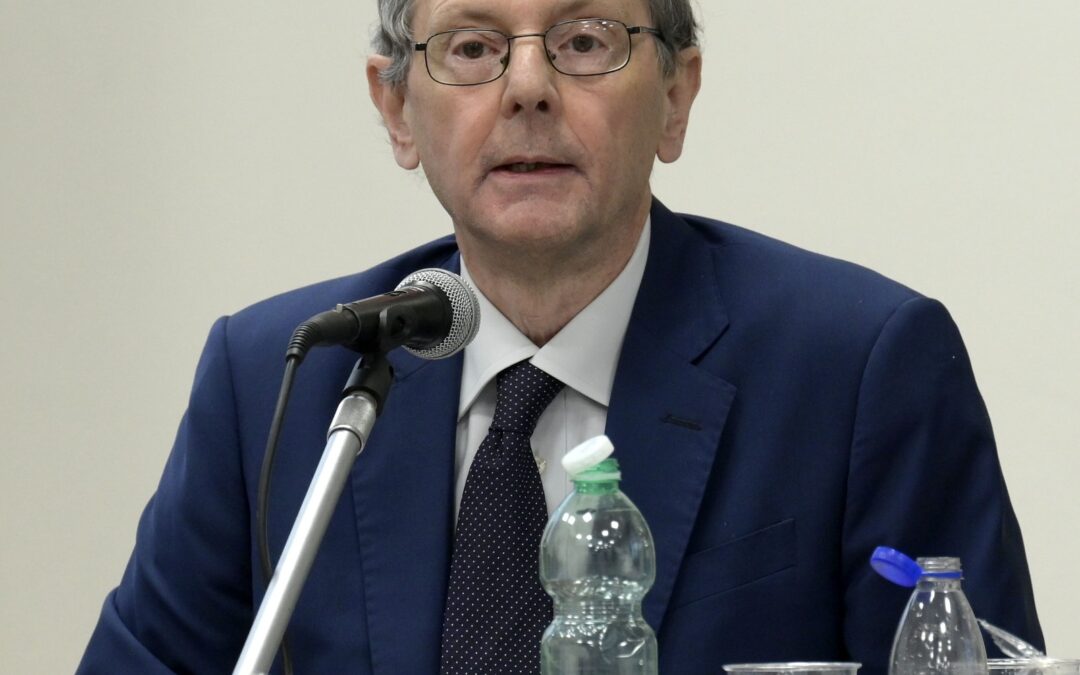
I thank Don Stefano and President Federico D’Andrea for the opportunity to share some information on a subject that has deeply interested and involved me. I’ve met over 30 people who have experienced a near-death event, either themselves or their parents. This involvement has led me, over the past 10–15 years, to collect numerous books.
I’ve donated to the IRIS 3 Foundation a collection of about a hundred books and articles in digital format, categorized by topic, to make it easier to access and understand a subject that is truly complex. There are now many publications—both scientific and popular—and two online databases containing thousands of testimonies.
Two collections have been underway for about thirty years. It is important to apply discernment—both to the facts and to the interpretations given to those facts. St. Thomas Aquinas said, “Everything that is true comes from God, but first we must determine what is true.”
One of the few Catholic authors on the subject is Dr. Patrick Taillet from the Medical Bureau of Lourdes. A priest recounted that Patrick Taillet was encouraged by Pope John Paul II to delve into this topic, otherwise it would be left entirely to the New Age movement. And so it has been: the topic is now largely within the domain of the New Age.
I don’t want to encourage people to say that near-death experiences (NDEs) definitely exist, because you might pick up any book and believe everything written in it. But that’s not how it works. We face many challenges on this subject. For example, I only began speaking about it and eventually discovered about thirty people with personal experiences. I suggest you do the same—only then will you encounter real cases.
The problem is that there’s a bias at the source—in the data collection and in the questionnaires used—and a bias in the interpretation of the facts. Let me give a simple example.
In these experiences, people often encounter God—a being of light, infinite and unconditional love—and they often see paradise. These accounts are often interpreted through a New Age lens. But statistics show that between 3% and 8% of experiences involve hell. These are then dismissed as errors, side effects of anesthesia or other substances, psychiatric conditions, or a result of Catholic guilt.
This is not true. These experiences follow recurring patterns across people of vastly different ages—including young children—and across diverse religious beliefs: atheists, agnostics, Buddhists, Christians, Muslims, Hindus. In India, they are now collecting many such testimonies, and so we see this spans across cultures.
Let’s clarify what we’re talking about. What are the common elements of Near Death Experiences (NDEs)? In Italian, this is often translated as “esperienza di pre-morte,” but that’s incorrect because these people weren’t dead. They were alive. There was no pre-death. “Near” means “close to” or “in proximity to” death.
So when do these NDEs happen?
One, in cases of extreme cessation of vital functions. The most documented are cardiac arrests, largely thanks to advances in resuscitation. A Dutch cardiologist devoted himself to this area and collected many cases.
Less common (and therefore less documented) are cases of brain death or severe brain compromise, such as the well-known case of neurosurgeon Eben Alexander. He was from Harvard, was an atheist, woke up a believer, and was miraculously healed—which statistically is extremely rare.
He became famous and wrote the book Proof of Heaven, but there are also intermediate cases involving serious conditions like surgery. Many people I interviewed described finding themselves outside their bodies during surgery, watching the procedure from above or even from elsewhere. Then there are simple life-threatening situations—such as a car going off the road or near-drowning—that also produce NDEs.
All these cases, regardless of brain state, share common phenomena. That’s important because it suggests these aren’t simply brain-generated illusions.
What do NDEs typically involve? If the experience is complete, it usually includes these phases:
Phase 1: Out-of-Body Experience (OBE)
The person leaves their physical body and possesses another form—one with senses. Even people blind from birth or who had lost their sight described seeing clearly—what was happening in the operating room, on other floors, or even at home. People with poor eyesight saw better, and usually saw from above. They were able to move according to their will, even great distances. OBEs also occur outside of NDEs and have long been studied independently. Jesuit priest Fr. Giovanni Martinetti wrote a book Life Outside the Body comparing OBEs to the mystical experiences of Catholic saints, especially bilocation. This subject requires courage, and the IRIS3 Foundation is courageous enough to address the theme of the spiritual soul. It’s about examining facts and comparing them to Catholic tradition. Unfortunately, no Catholic theologians have conducted a serious theological reflection on these experiences. We only have a couple of Protestant preachers—one was an atheist before converting after his NDE. Disseminating information is one thing, but a thorough theological analysis is another.
Phase 2: Life Review
People relive key moments of their lives as if watching a film, but with new understanding. The first person I ever spoke to was a schoolmate who had attempted suicide twice. During her NDE, she felt the presence of God, unconditional love, light, and peace. She saw her entire life flash before her eyes while the car was crashing. God—or the being of light—showed her how much love she had received.
Years later, I’m still moved. I bought the related book when I met her again by chance. She later died of AIDS, but never again feared death thanks to that experience.
Phase 3: Crossing a tunnel and then finding yourself in the afterlife.
Most describe a tunnel; others use metaphors for a passage to the afterlife.
Phase 4: Meeting Deceased Loved Ones or Angels
Sometimes these include siblings who died prematurely and whose existence was previously unknown—verified later with parents.
Phase 5: Meeting God
Described as a being of infinite, unconditional love and light—even by atheists, though they don’t call it God. One atheist Russian scientist, captured in a video testimony, said: “Imagine the embarrassment of an atheist talking to God.”
Alternatively, people meet Jesus—Christians, atheists, Buddhists, Muslims. Then comes a symbolic vision of paradise—either a radiant city like in Revelation or a harmonious garden like in Genesis.
Alternate Experience: Hell
Descriptions vary from classic imagery to a desolate desert. Some include devils dragging people into hell.
Additional Experience: Purgatory
Since Protestants don’t have a concept of purgatory, they don’t recognize it as such—but it often appears, especially in stories where an angel introduces the person to Jesus, who brings them to a place clearly resembling purgatory.
Then follows a rapid return—often involuntary—prompted by a message: “It’s not your time.” Afterward, people undergo profound life changes—not just regarding belief in God and the afterlife, but also in what they value, how they live, and how they make choices.
Everyone I met changed for the better—but free will remains.
People typically take two steps forward and one step back. Even Eben Alexander is still human—he didn’t become infallible.
Theologically, they received a special grace—a step forward in their conversion. Who took advantage of that grace and who did not—only God knows.
Interestingly, many forget parts of their experience—especially what God told them was their purpose in returning. Free will is preserved.
In Conclusion: What Is Missing?
What’s missing are qualitative and quantitative studies conducted in hospitals, using questionnaires that allow for statistical analysis—along with interviews that can capture elements not covered by the questionnaires. These studies must be conducted quickly after the experience for better accuracy.
We need more detailed surveys. Online testimonies are helpful, but in-person hospital interviews are better—despite privacy issues. And finally, as I said earlier, the Catholic Church needs to undertake a systematic theological reflection on these experiences—once we’ve verified their reliability. Thank you for your attention.


