
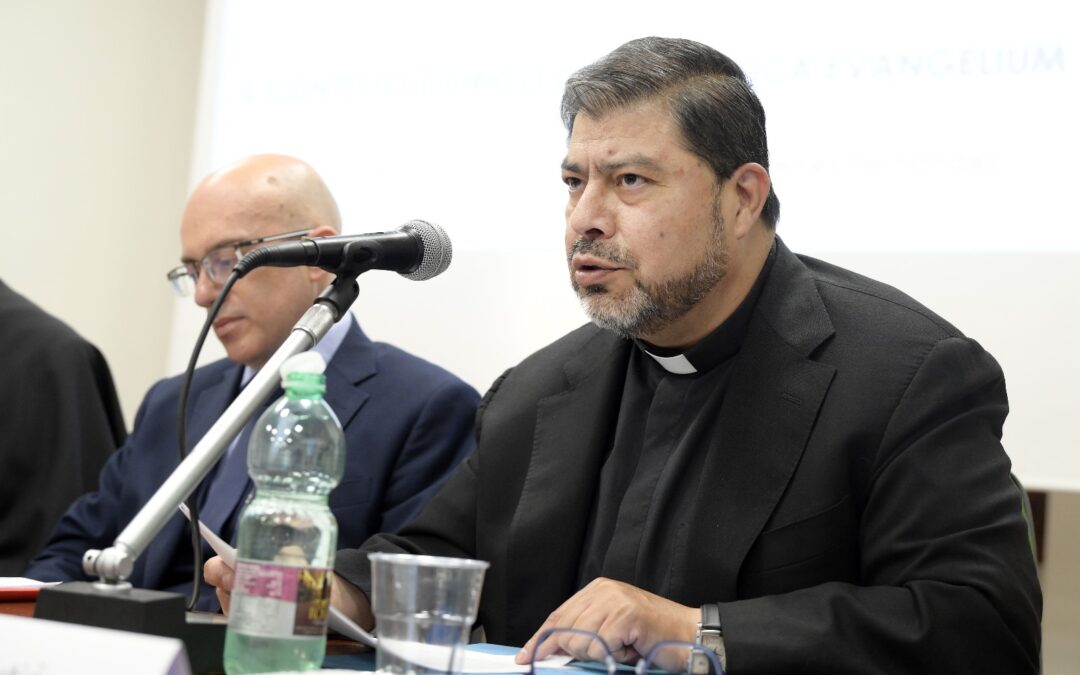
Dr. José Guillermo Gutiérrez Fernández
I warmly greet His Eminence Cardinal Gerhard Müller, who preceded me in the presentation, and the other colleagues who will speak this afternoon.
I sincerely thank father Stefano Tardani and the friends of the “Famiglia piccola Chiesa” Association, who have kindly invited me to come to Rome to participate in this symposium and to learn about their interesting IRIS-3 project.
This year we are celebrating 30 years since the encyclical of the Holy Pope John Paul II, Evangelium vitae. Throughout this time, much reflection has taken place on its content, and it might seem that there is nothing more to say. However, each time we return to this prophetic text, new aspects for reflection emerge. This is the case, for example, with the topic that brings us together today: The dignity of the human person and the spiritual soul.
It is undeniable that in the history of humanity, never before has so much importance been given to the protection of human life. In fact, in modern, democratic, and liberal societies — where the majority of people live — this protection of life has been carried out in a broad and effective way. Despite wars and the many forms of crime and violence that continue to afflict large sectors of humanity — and which in recent years have increased — individuals have the reassurance that their physical integrity, in principle, will be guaranteed by the State. Practically all modern state constitutions affirm the principle of the right to life. However, paradoxically, never before has the life of innocent human beings been so threatened as it is today. Our contemporary civilization lives in a cultural situation of enormous contradiction. On the one hand, it ensures broad protection of life and the security of all citizens, but at the same time, it has produced structures and new forms that attack life and the dignity of persons, claiming to be legitimate from the legal point of view.
It is true that throughout history, in various forms and circumstances, human life has always been threatened — let us think, for example, of wars, homicides, abortion, torture, and the exploitation of labor power that harms life. [1]. Nevertheless, while in the past these attacks, with virtually no fundamental objection, were given a negative moral judgment and classified as crimes, today they are increasingly being tolerated and even accepted. The new perspectives opened by scientific and technological progress have given rise to new attacks on life, with new nuances and unprecedented outlooks, so that some of these assaults occur in the field of biomedicine — as in the now well-known cases of voluntary abortion, destructive experimentation on embryos, and euthanasia. These are new forms of threat to the dignity of the human being, which outline and consolidate a new cultural situation. In the eyes of many people, they are acceptable and even unquestionable, given the moral authority of the medical profession and the scientific context in which they take place. Moreover, under the influence of major ideological campaigns, they are perceived as rights rooted in individual freedom. And on this basis, in many cases, it is demanded that they be legally recognized, and that they be carried out with the financial support of the State through free assistance from the healthcare system and medical personnel.[2].
The encyclical Evangelium vitae rEvangelium vitae expresses concern over the obscuring of the value of life as one of the defining features of this new cultural situation, [3], fto the point of stating that we are in the midst of a dramatic struggle between the “culture of life” and the “culture of death.” [4] It accuses contemporary society of fueling a war of the strong against the weak[5]. Quella che il recentemente scomparso Papa Francesco ha definito una “cultura dell’usa e getta”. At the same time, the encyclical acknowledges several positive signs that point to the growing protection of the right to life, so widely proclaimed in contemporary societies. Among these are greater attention to quality of life and ecological issues, efforts to bring medical care to the poorest regions, [6] and a growing sensitivity against war and the death penalty. Yet, as has been noted, despite these commendable efforts to protect life, there remain enormous and radical contradictions within the very heart of society.
Martin Rhonheimer,[7] for example, states that although most people, in principle, would want to exclude practices such as abortion and euthanasia from their own personal behavior, at the same time, a large number of them are willing to tolerate others engaging in these practices freely if they consider them justified. For this reason, they reject the idea of making them legally punishable, on the assumption that doing otherwise would imply intolerance and unjust discrimination. But this concept of tolerance is no longer simply the enduring of a practice that, although considered detestable, is not penalized in order to safeguard higher values such as peace. Rather, it is the acceptance that certain behaviors — while not seen as appropriate for oneself — are nonetheless recognized as legitimate alternatives for others. [8] This conception inevitably impacts how people think, feel, legislate, and perceive values. It entails a profound transformation at the cultural, structural, and psychosocial levels.
Finnis notes that the term “culture of death” should not be understood as claiming that modern culture as such, or Western culture as such, or the secular world as a whole, constitutes a culture of death. Rather, the term indicates that in our contemporary world, there is a strongly present and clearly identifiable set of interrelated practices, agreements, laws, institutions, modes of acting, thinking, and communicating, of interpreting, and learned patterns of wanting and desiring — which taken together can rightly be called a “culture of death.” “The word ‘culture’ implies something more or less enduring. The phrase ‘culture of death’ indicates a disposition — more or less stable and shared — to make and carry out choices in a certain direction; a pattern of intent, more or less open and consistent, public and unashamed. What is distinctive about this set of attitudes and practices is that those who share them are willing to attempt [9] – death.
In summary, the “culture of death” consists of a set of attitudes and behaviors, as well as institutions and laws, that fail to respect the value of human life. It views the deliberate death of certain classes of people as something legitimate in order to solve particular problems or alleviate suffering — sometimes grave and complex [10]. This is not merely a matter of individual selfishness but of a social consciousness that, lacking belief in the inviolable value of human life, claims ownership over it. Even though the fundamental equality of human beings may be formally upheld, in practice, unjust discriminations are established[11]. Some are loved, while others are deemed unworthy of life or believed to be better off not living.To justify this, the concept of “quality of life” is invoked [12]. — often using reductionist and arbitrary criteria to measure it, such as economic efficiency, consumerism, physical beauty, and the ability to enjoy physical life — while entirely ignoring or neglecting the spiritual, relational, and religious dimensions of existence.[13].
2. The Causes of the Current Cultural Situation.
John Paul II states in the Encyclical that attacks on life sometimes arise from personal situations of deep suffering and moral confusion, which can even lessen subjective guilt. However, the phenomenon is much broader, and one can precisely speak of a true structure of sin, characterized by the imposition of an anti-solidarity culture, actively promoted by powerful cultural, economic, and political currents that advocate an efficiency-driven conception of society [14].
According to the Pope, the causes of this cultural situation lie in an idea of freedom that he does not hesitate to describe as “perverse,” as it leads to a striking contradiction [15]. This is precisely the contradiction we have been referring to: on the one hand, solemnly proclaiming the inviolable rights of the person — among them the right to life — and multiplying initiatives without distinction of any kind, while on the other hand threatening civil coexistence by effectively denying this value and this fundamental equality, through the rejection of those most in need, the elderly, the weakest, and the unborn. In doing so, our societies cease to be communities of coexistence and become societies of the excluded, putting at risk the culture of human rights [16].
Although it is the State’s duty to protect human life in its physical integrity, this task is today de facto challenged in two areas: at the beginning and at the end of life. Caffarra [17] shows how the justification of abortion and euthanasia is the result of a project that is reaching its conclusion — one that defines the human person solely as a subject whose original and complete definition is the freedom of choice. Precisely at these two moments — at the beginning and at the end of life — the person’s freedom is challenged to carry out its own decisive act. When a person is confronted with the beginning of a new human life, they must make a decision regarding the ultimate reasons for existence. In fact, the conception of a new human being places man before the need to answer the question about the origin of that person. If the new human being is merely the causal result of a set of biological, natural, and impersonal events, then that being is reduced to just a “moment” in a process, without it being possible to attribute it to an eternal and personal self. Thus, no special dignity accompanies that being. The greatest gift that can be granted to man — that of depending on Someone eternal and personal — is lost, and man is reduced to dependence on a thing. From this perspective, the justification of abortion as a right — that is, as a prerogative founded on the order of justice — is the radical affirmation of a project of liberation that seeks to align itself with the eradication of the person from being. That is, it is the decision to consign man exclusively to himself. The same happens at the end of life, and perhaps even more radically. Faced with the end of life, one must choose between self-justification or justification by another of what is finite. Eradicating the person from the Mystery that dwells within them means, above all, justifying suicide — and even ennobling it as a choice for life, for quality of life. Man is to judge when his life is worthy or unworthy of being lived.
The root of all this lies in three events that have shaped it. First, the denial of the orientation of the intellect toward truth. If it is denied that conscience is originally the awareness of being, and being is reduced to conscience, then truth is wounded at its root and is replaced by consensus. Secondly, and as a consequence of the above, there arises an experience of freedom that is founded on nothing other than itself. It is self-referential and simply constitutes human existence. Thirdly, we find the ultimate consequence of this process: the elevation of utility or pleasure as the only criterion of truth. There was only one way to justify taking control over the beginning and end of life — to affirm that man is the absolute master of himself. In other words, that freedom is “indifferent” and must decide autonomously. This explains why abortion is justified as “self-determination” and euthanasia as the “choice whether to live or not.” And in this way, the final result is pure permissive sensualism. The isolation from all objectivity, from all reality that exists independently of us — this distancing — has left contemporary man in a playful atmosphere in which the only criterion of objectivity is the individual’s own mood.
This interesting analysis aligns with what the Encyclical states. John Paul II identifies the root of this paradoxical contradiction in an erroneous concept of freedom, which he describes as the absolute exaltation of the individual, which does not lead to solidarity, full acceptance, or service to others. Such a concept of freedom as pure self-determination depends, the Pope says, both on a distortion of subjectivity — one that recognizes as the bearer of rights only those who demonstrate full or at least incipient autonomy — and on the theory that identifies personal dignity with the capacity for verbal and explicit communication. The Encyclical emphasizes that from these premises, it is impossible to uphold the inalienability of the human subject, which is the foundation of human rights. Nor is there room in the world for those categories of human beings who are structurally weak and dependent, and who can communicate only in the silence of a mutual symbiosis of affection — as is the case with both the unborn and the dying — leaving them at the mercy of others, which means that force becomes the criterion for choice and for action.
3. Materialism and the Denial of the Spiritual Soul as the Ultimate Root of This Process.
From what we have said, it seems evident that the reduction of the human person to the solely material dimension — to biology and physiology, to the neural connections that make consciousness and autonomy possible — is the root of the inability to uphold the inalienability of human life. Indeed, the Christian conception of man sees the intangible dignity of the human being as founded on his being in the image of God, in such a way that man in his entirety — of immortal spiritual soul and matter — has as his ultimate end personal communion with God in a life beyond death, as Cardinal Müller highlighted in his presentation. But if, as we have said, the current cultural context affirms the emancipation and absolute freedom of the person and confines human life only within the horizon of temporality and finitude, whose end is therefore total annihilation, then there is no room to consider human dignity as absolute. That which is destined for nothingness cannot have absolute dignity, nor can unconditional respect be required for it.
Thus, we encounter an objection that deserves to be taken seriously. It is this: does the Church, through its moral teaching, not place limits on scientific research — limits that mean obstacles, perhaps insurmountable ones, or at least delays in achieving possible useful results for human health, toward which that research is directed? The objection is strong: the Church, in seeking to save humanity, in fact prevents the good of humanity itself. The same objection arises in relation to suffering: the moral teaching of the Church goes against all legitimate effort to avoid, as far as possible, unbearable or extraordinarily burdensome suffering. One could think of prenatal diagnosis aimed at preventing the birth of human beings with severe limitations, which would justify the need for abortion.
This objection calls for a response, which I will now only outline in its fundamental features. As can be seen, it raises a question that goes beyond the field of biomedicine: is it morally permissible for man to do everything that he can from a techno-scientific point of view? Or at least: is it permissible to do everything that he can physically do when it concerns actions that will produce a useful result for human life? This question leads to another, which is the underlying question needed to establish valid criteria: what is man? And to answer adequately about the meaning of human life, it is also necessary to ask about its ultimate end. As we can see, the problem leads us to the traditional question from the Catechism: for what end are we on this earth?
Much has been said in recent years about the urgent need to develop a new anthropological synthesis. I believe that the project you have undertaken goes in this direction and will constitute a valuable contribution. It is not a matter of setting aside our rich tradition, for as I have just demonstrated, the fundamental questions are always ultimately the same, albeit in new cultural contexts. But it is about engaging a new creativity of faith, having as perspective the hermeneutics of continuity — that is, the coherence of faith — which for us always constitutes the princeps analogatum.
Returning to the argument I have been making: the Holy Pope was well aware that without a valid answer to the questions we have raised, his argument in defense of life as an absolute value would be left without a foundation. His response — one of both faith and reason — is as follows: earthly life has its own order and purpose, and therefore a meaning in itself. But this meaning is not complete; it is open to the subsequent phase, in which the exercise of freedom during earthly life will be fulfilled in a definitive outcome: salvation or eternal condemnation, as expressed in the language of Christian faith. Therefore, the life that the encyclical describes as a “fundamental” and “primary” good [18], is at the same time, according to the same encyclical, relative and a “penultimate” reality, so that bodily life and its earthly dimension are not an absolute.[19].
In this acknowledgment of man’s destiny, and therefore of his ultimate meaning, is grounded the sacredness of life in its earthly phase. Christian revelation has provided an important light capable of illuminating the binding character and the fundamental content of the moral imperative that every man perceives in his conscience. It is only in this light that one can understand the unconditional respect for life from conception until natural death, even when it is marked by suffering. But it is precisely here, at this foundation, where many people of our time find difficulty in accepting the Christian message without compromise. It is true that this is a message that human beings can understand rationally and that resonates within them; it is not a prerogative of Christians alone [20]. But the Pope himself points out that this message of the inviolability of innocent human life, which reason is capable of grasping, can only be truly embraced through the secret influence of grace, which operates beyond the visible boundaries of the Church.[21].
In conclusion, I wish to reaffirm that here I have recognized — along with many authors — the validity prima facie of the objection against the “Gospel of Life.” But this validity in turn has limits, which it is necessary to recognize without illusions. I will express it as the Jesuit Fr. Sala, one of the first members of the Pontifical Academy for Life, used to say: “Are we sure that an unlimited freedom to manipulate and reject life in order to raise the ‘quality of life’ during its earthly phase will lead humanity to a more humane life? Are we sure that the final result, based on the censorship of suffering and pain — which should always be avoided [22], — will ultimately give rise to a life more worthy of being lived than under the lordship of God?” [23]. History shows us how the eclipse of God always ends up leading to the eclipse of man and to greater suffering. Hence, I consider that the endeavor you intend to undertake — to study and demonstrate in the present time the existence of the spiritual soul created directly by God and in a special relationship with Him as the foundation of human dignity — is all the more urgent.
[1] See EV, nn. 3 y 8.
[2] See EV, nn. 4,11, 18 y 68.
[3] In number 4 we can read: “Si ipsa exstinctio tot vitarum humanarum sive nascentium sive deficientium permovet nos atque conturbat, haud quidem minuis movet id turbatque, quod conscientia ipsa, ita late propagatis condicionibus adfecta, aegrius et difficilius usque discrimen inter bonum et malum percipit iis in rebus quae principale tangunt vitae humanae bonum.
[4] See EV, nn. 21, 50 b, 95.
[5] See EV, n. 12.
[6] See EV, nn. 26 y 27.
[7] See RHONHEIMER, M., Etica della procreazione, Pontificia Università Lateranense- MURSIA, Roma 2000, pp. 5-6.
[8] For example, the case of those who, while considering homosexual practices as something negative, continue to support the legalization of same-sex unions, or the interventions of some politicians who consider themselves Catholics and therefore claim to reject abortion, but at the same time support its decriminalization and legalization, in the name of tolerance and respect for minorities that should prevail in a democratic political system.
[9] The translation of the English word “intend” is difficult. It is the Latin word intendere, which is also difficult to express in English; intendere is in fact a “tending toward,” a “wanting (to do).” Some authors, such as Martin Rhonheimer, translate it as “in-tend”; here we have sometimes translated it as “try,” putting the English word between hyphens.
[10] See MIRANDA, G., “Cultura della morte”…, p. 237.
[11] Rhonheimer notes that the “culture of death” is marked by a new and very dangerous connection between protection and threat to life. On the one hand, in our modern societies, priority is given, as never before, to the protection of the person’s physical integrity, health care and support for all types of people with disabilities. But on the other hand, this same society, with its complex network of social security and public and health care institutions, develops an increasing tendency to exclude from this system those elements that hinder and burden it. This, in truth, is in accord with fairly recognizable interest structures that discriminate against certain groups of people. Otherwise, it would be inexplicable why precisely the killing of the unborn is advocated as a benefit of welfare and health care institutions, while, on the other hand, the public tendency is rather to favor practices that enable the reduction of such benefits for the disabled, preventing them from even coming into the world, thanks to the promotion of prenatal diagnosis, practiced with selective intentions. Thus, public health care develops discriminatory structures, based on the interests of those who are born, those who make money, those who are healthy, etc. The strong push for euthanasia, especially in industrialized and developed countries, can also be interpreted in this sense. It is a fact that the elderly are increasingly becoming a burden on the health care system due to medical and technical progress, increasing life expectancy, and the growing disproportion between the economy and pensions. However, for now, they are exempt from the risk of discrimination because the mechanism of democracy based on majority ratios is still in place and, in these developed nations, they increasingly constitute the majority. But this could change when young workers feel their interests threatened, outvoted by an older generation. See Rhonheimer, Etica…, p. 12.
[12] For a critical view of the concept of “quality of life,” see: SGRECCIA, E. – CARRASCO DE PAULA, I. (a cura di), Qualità della Vita ed etica della ricerca, Atti dell’Undicesima Assemblea Generale della Pontificia Academia pro Vita (21-23 Febbraio 2005), LEV, Città del Vaticano 2006.
[13] See EV, n. 23 b.
[14] See EV, n. 12 a.
[15] See EV, n. 18 y ss.
[16] In this regard, Marcello Pera said that while classical liberalism contains principles and values that, by history, tradition or culture, have been assumed as the foundation of the social community, in Western societies these shared values refer back to their Christian roots, which profess that all human beings are equal, as brothers and sons of the same God, and, consequently, each person can enjoy the same freedom while respecting the freedom of others, showing solidarity with others, thus ensuring social cohesion. This foundation has been increasingly lost, producing a contradiction, a certain intellectual and behavioral schizophrenia: on the one hand, state declarations purport to recognize “fundamental rights,” that is, rights that are not granted, enacted or constructed, but rather accepted as ethical facts; and, on the other hand, states themselves now consider these fundamental rights to be moldable material on which to intervene with positive legislation. (See PERA, M., Relativismo, liberalismo e crisi della famiglia. Conferenza tenuta alla XVIII Assemblea Plenaria del Pontificio Consiglio per la Famiglia, Città del Vaticano, 3 aprile 2008).
[17] See CAFFARRA, C., “Veritatis splendor”-“Evangelium vitae”: Il destino dell’uomo, in LOPEZ TRUJILLO, A., HERRANZ, J., SGRECCIA, e., (ed.), “Evangelium vitae” e diritto. Acta symposii internationalis in Civitatae Vaticana celebrati 23-25 maii 1996 , LEV, Città del Vaticano 1997, pp. 33-35.
[18] See EV 2.
[19] See EV 47.
[20] See EV 101.
[21] EV 2.
[22] See EV 23.
[23] SALA, G., Continuità e novità nel Magistero della Evangelium vitae in PONTIFICIA ACADEMIA PER LA VITA, La Causa della vita, Città del Vaticano 1996, pag. 37.


